WINNING WITHOUT THE MEGA CAPS
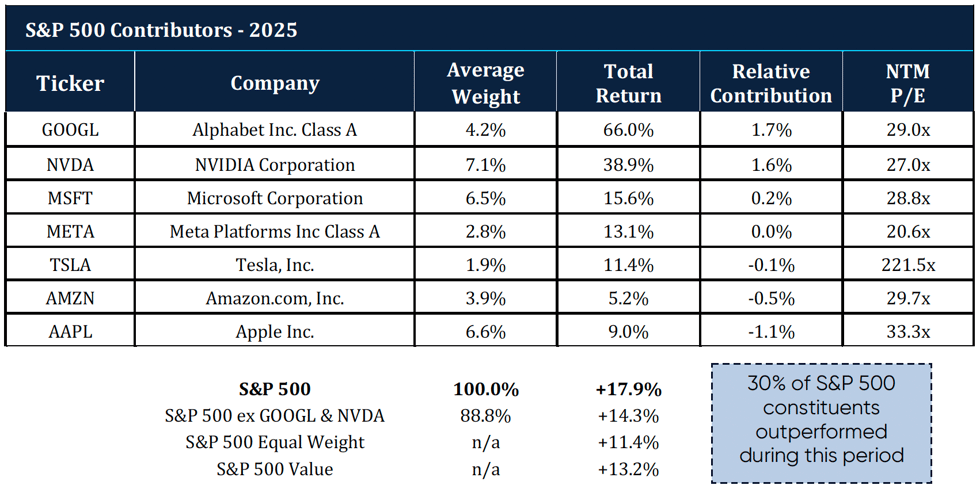
The most surprising aspect of our 2025 performance is that our U.S. stocks, which made up 63% of the portfolio, managed to return 23.0% in the year, ahead of the 17.5% and 17.7% returns from the S&P 500 and the U.S. portion of the MSCI World Index, respectively. In this section, we refer to the S&P 500 Index, which is a good proxy for U.S. returns within the MSCI World Index. The table below shows that this outperformance was difficult to achieve without mega-cap tech stocks. Alphabet and NVIDIA combined added 3.6 percentage points to the S&P 500 Index return. Without them the S&P 500 Index would have gained just 14.3%.
Other mega-cap growth stocks outside the Magnificent Seven also contributed outsized return contributions to the S&P 500 Index. As a result, the S&P 500 Equal Weight Index returned 11.4%, 6.5 percentage points below the S&P 500 Index, and an additional 2.9 percentage points below the S&P 500 Index excluding Alphabet and NVIDIA.
We have not owned any of the mega-cap growth stocks that have inflated U.S. stock returns, yet our U.S. stocks still outperformed the S&P 500 and the S&P 500 Equal Weight indices. How did we do it?
In short, our strong fundamentals led to the strong outperformance. Excluding CNH Industrial and Grupo Catalana Occidente, which we sold at the beginning of the year, and ICON, which we purchased at the end of the year, we owned 26 stocks through the course of the year. Of these, 88% grew their forward earnings at an average rate of 13.3%, outpacing the MSCI World at 9.6%. Of those three stocks that saw forward EPS declines, only Centene saw a significant sell-off.
 Source: Lyrical analysis
Importantly, these losing stocks barely impacted our performance on the downside. As shown in the top five contributors and detractors below, only two stocks—NetApp and Centene—managed to deliver greater than 10 basis points of negative contribution in the year.
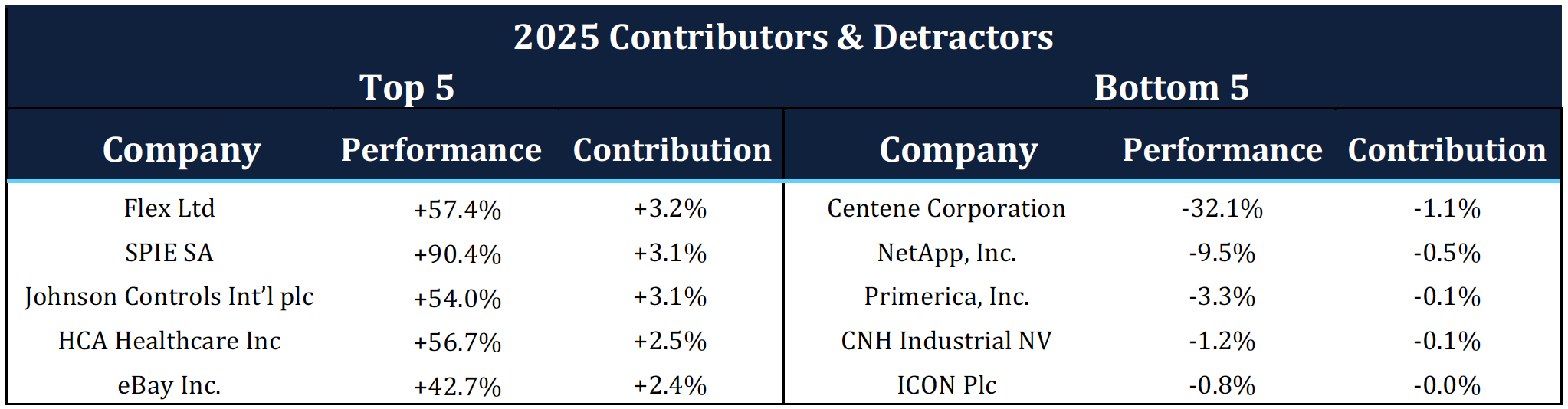
On the flip side, the performance of our winners was broad-based. Beyond the top five winners shown above, 15 stocks—more than half the portfolio— each contributed over 1 percent to our performance and 20 stocks each delivered over 50 basis points of positive contribution.
LOOKING DIFFERENT
The past year marked the third year in a row that the MSCI Sustainable Impact index trailed the MSCI World Index. We believe these last three years have helped prove our original thesis that valuation always matters, even in the sustainability space. Since 2023, the MSCI Sustainable Impact Index returned only +13.9% cumulatively compared with GIVES at 61.2%.
Many of our peers in the impact space did not fare so well because they crowded into the same obvious impact businesses despite the high valuations of those stocks. Even after the under performance of the past three years, the largest impact funds continue to look virtually identical in terms of their holdings. To show this, we use theeVestment database to look at the holdings of the largest 15 actively managed global sustainable and impact funds that have fewer than 100 holdings. As shown below, 17 stocks were found in six or more funds, and the most common company, Microsoft, showed up in 11 of the 15 funds. Notably, all these stocks except one trade for more than 20x P/E.
There’s a lot to like about obvious impact businesses. Not only do they improve the world, they also typically benefit from secular growth. However, overpaying for any business, even an impactful one, will generate a poor return.
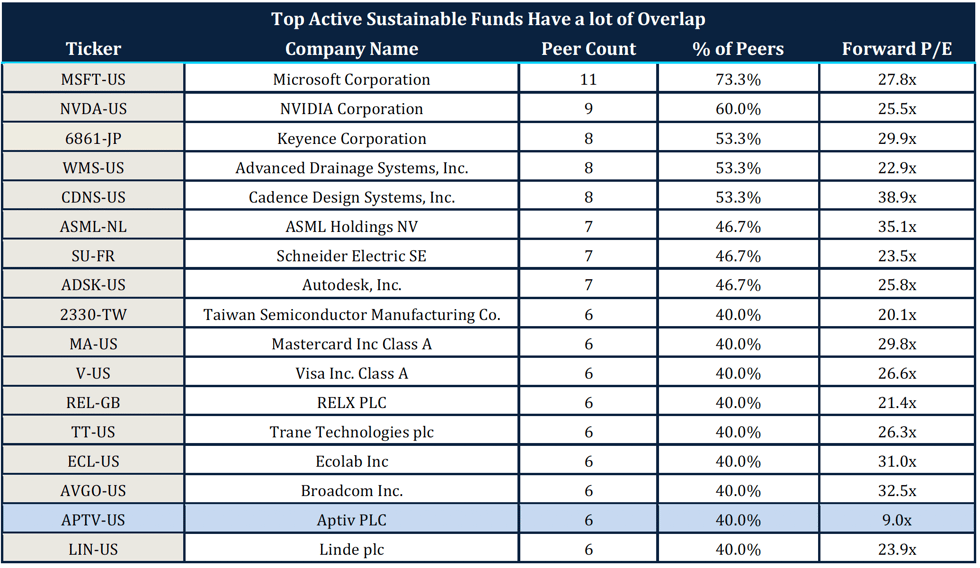
Compared with our peer set, it would be hard to look any more different. Of the most common impact stocks above, Lyrical only owns one company, Aptiv, which is highlighted in blue. Unsurprisingly, Aptiv is the only reasonably priced stock in this group, trading at a valuation of only 9.0x forward earnings.
Notably, Aptiv did not always trade for a cheap valuation. As one of the leading suppliers into the EV ecosystem, Aptiv was a consensus buy back in the bullish days of sustainability. The stock traded for a sky-high multiple above 30x P/E in 2020 and 2021. Then, as happened with many of its peers, Aptiv’s multiple collapsed back to earth in 2022 and 2023. We’ve always admired Aptiv, both for its impact and for the quality of its business, but our valuation discipline kept us from buying the shares until May 2024, when they traded for 12x forward P/E.
ENGAGING WHERE IT MATTERS MOST - CLIMATE CHANGE & NET ZERO
The companies we own are making a clear positive impact on the world, but these non-obvious impact companies can require additional support insetting ambitious targets. This is one of the areas where we engage with our businesses. This is especially critical when it comes to climate change, as reaching net zero is one of the pressing challenges of our time. The importance of net zero has only grown amid systemic barriers that emerged in 2025, such as the rollback of renewable energy and electric vehicle incentives in the U.S., as well as increasing regulatory fragmentation across geographies.
To overcome climate-related challenges and support our companies in growing their impact, Lyrical set a net zero target in 2023, aiming to have 75% of GIVES’s portfolio companies (other than those with immaterial GHG emissions) developSBTi-approved net zero targets by 2030. As with our investing and research, we accomplish this by engaging in a structured process and practicing proactive stewardship. When we initially invest in a business, we show them where they are positioned within the table below. The table shows our GIVES companies and where they stand on SBTi alignment, from immaterial emissions on the left to approved SBTi targets on the right.1 We explain to the management of the businesses that our job is to move them to the right on the table below, pushing them to develop SBTi-approved net zero targets.
1Notes: Ayvens and Konecranes targets are pending SBTi-approval.Companies in red collectively comprise approximately 86% of the portfolio’s reported Scope 1-3 emissions (on an unweighted basis). Flex is a high-priority net zero engagement due to the company’s lack of progress on reducing Scope 3emissions, which are the second highest in the portfolio
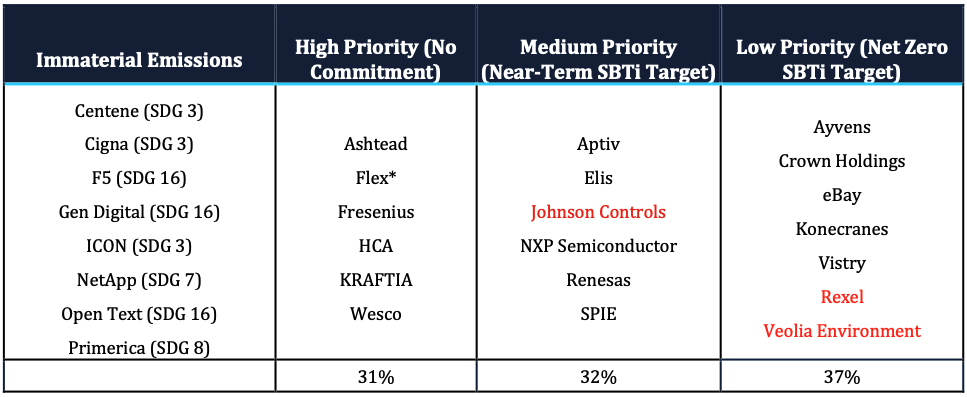
This clear and simple net zero framework helps us focus on where engagement is most needed and where we can affect the most change.
MOVING COMPANIES IN THE RIGHT DIRECTION
In 2025, we’ve seen solid progress toward our net zero target. As of year-end, 37%of GIVES’s portfolio companies with material emissions have committed to or set an SBTi-approved net zero target, an eleven percentage-point increase from the prior year. These companies include Crown Holdings, eBay, Konecranes, and Vistry. When looking at the portfolio as a whole, 74% of our companies with material emissions have made near-term and net zero SBTi commitments, and their unweighted absolute and intensity-based Scope 1-3 emissions are 20% and 76% below the MSCI World, respectively. We believe this is a strong indication of the success of our companies in generating positive impact in the world, while reducing their own negative externalities.
ENGAGING WITH PURPOSE - EXAMPLE: WESCO
This year, we made significant progress pushing Wesco to report scope 3 emissions, a key step in getting them to net zero. Wesco is a clear impact leader by distributing and promoting renewable and energy-efficiency products, which we estimate will avoid 18.9 million tCO2e from 2024-27. While the company is an impact leader, we continued to engage Wesco in 2025 because it has not made an SBTi commitment and remains a high priority under our GIVES net zero strategy.
A key barrier to setting certified SBTi targets is measuring and disclosing Scope 3 emissions. Scope 3 accuracy is critical because it enables companies to identify emissions hotspots across their value chains and develop decarbonization plans that deliver measurable emissions reductions. We began pressuring Wesco to measure Scope 3 back in 2024, including a site visit and numerous meetings with the CEO. At first, they balked at the idea that their Scope3 could accurately be measured; there were simply too many products (1.5million) from too many suppliers (30 thousand) to measure the ultimate emissions generated, they said.
We worked with the company, noting they could use a third party to help them make an accurate estimate. We collaborated with CDP to provide Wesco with a list of reputable verification firms, and we showed Wesco how other firms had successfully undergone the measurement exercise. A similar portfolio company based in Europe, Rexel, had adopted an activities-based approach by building a database of product-level data over five years. We shared that with Wesco, prompting them to pursue a similar approach.
Ultimately, Wesco notified us at the end of 2025 that they had hired a third party to help them and that they plan to disclose Scope 3 by 2027. We applaud Wesco management for their efforts; Wesco must work closely with suppliers, who are primarily based in the U.S.. These suppliers are not as far along in terms of measuring their products’ emissions as some of their European counterparts. We will continue to work with Wesco in 2026 on Scope 3 measurement, target setting, and the development of a decarbonization plan so it can reach net zero by 2050.
Through focused engagement, like our engagement with Wesco, we have seen our companies make significant strides towards net zero.
WAITING, PATIENTLY, FOR THE PAYOFFS
We had a strong year in 2025 because of our earnings fundamentals, not because of market factors. That said, we are well positioned to take advantage of what we see as the upcoming mean reversion in two major areas of the market: size and value.
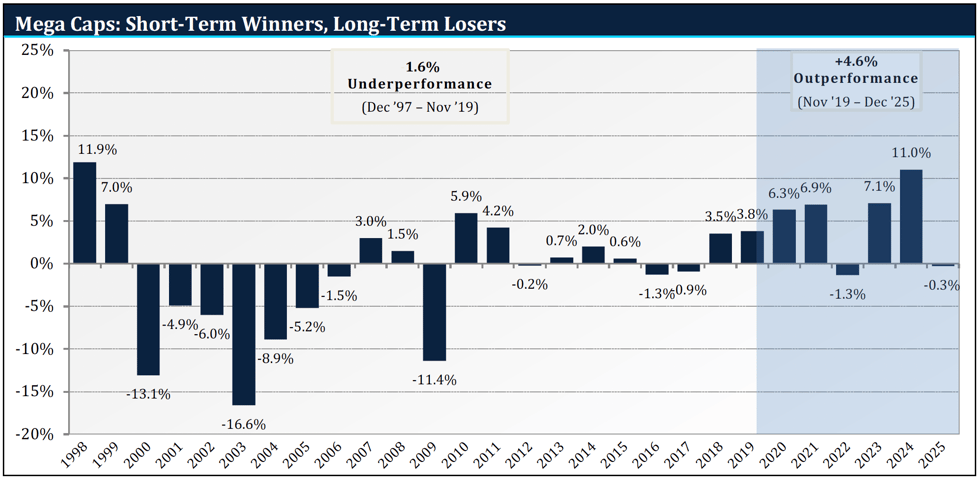
First, size has been a major headwind, but we expect that to turn to a tailwind in the future. With a weighted average market cap of $36 billion, our portfolio looks much more like the MSCI World Equal Weighted Index, which has a $74 billion average market cap, than the MSCI World Index, which has a $1,029 billion market cap. This has resulted in a significant headwind. As shown below, since we launched our fund in November 2019, the cap-weighted MSCI World has outperformed the equal-weighted MSCI World by 4.6 percentage points per year.
Source: Factset. See Notes below.
For larger market caps to beat smaller market caps with this level of magnitude and duration is highly unusual, and we don’t expect it to last. As also shown above, between December 1997 and September 2020, the cap weighted version of the index underperformed the equal weight by 1.6 percentage points per year. The current period of mega-cap outperformance looks most like the period experienced in 1998 and 1999, during the tech bubble, when mega-cap stocks massively outpaced the market before collapsing.
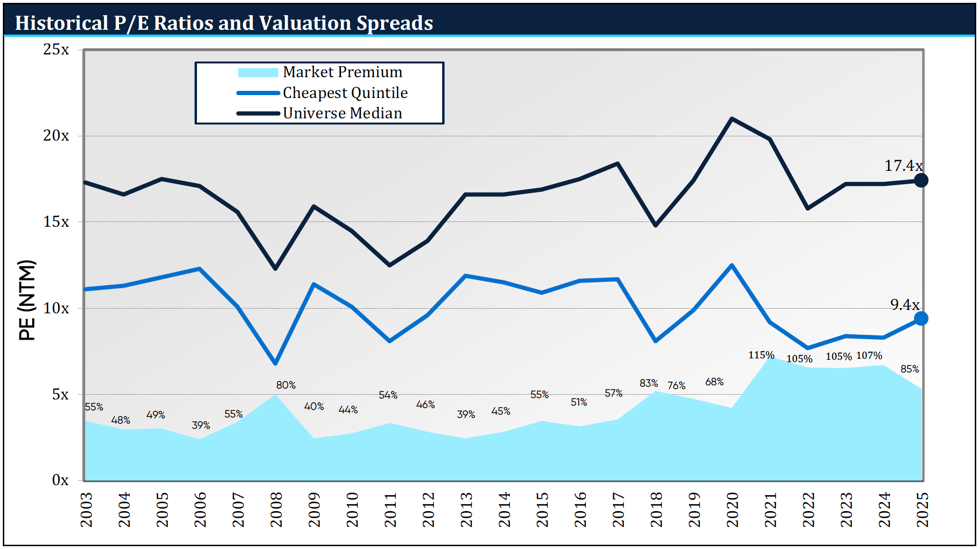
Another mean reversion opportunity that reminds us of’98-’99 is the value factor. Below we show the median P/E multiple of global developed market stocks in the dark blue line, and the median P/E of the cheapest 20% of stocks in the royal blue line below it. The bars at the bottom show the spread between the two lines, or how expensive the market is relative to the cheapest part of the market. With a spread of 85% today, the market is priced at a similar valuation spread as it was at the end of 1999. This was right before value stocks went on their best period of relative performance that we have data for. From March 2000 to July 2007, the cheapest quintile of global stocks outperformed the MSCI World by 18.7 percentage points, delivering a 22.4% annual return versus the MSCI World at only 3.7%.
While it’s easy to see that the magnitude of potential returns from size and value is significant, it is impossible to say when these returns will be realized. Fortunately, we can afford to be patient. Unlike the typical value stock, our companies have strong earnings growth which can carry us through periods when the market is not in our favor.
OUR UNCOMMON COMBINATION - VALUE, QUALITY, GROWTH
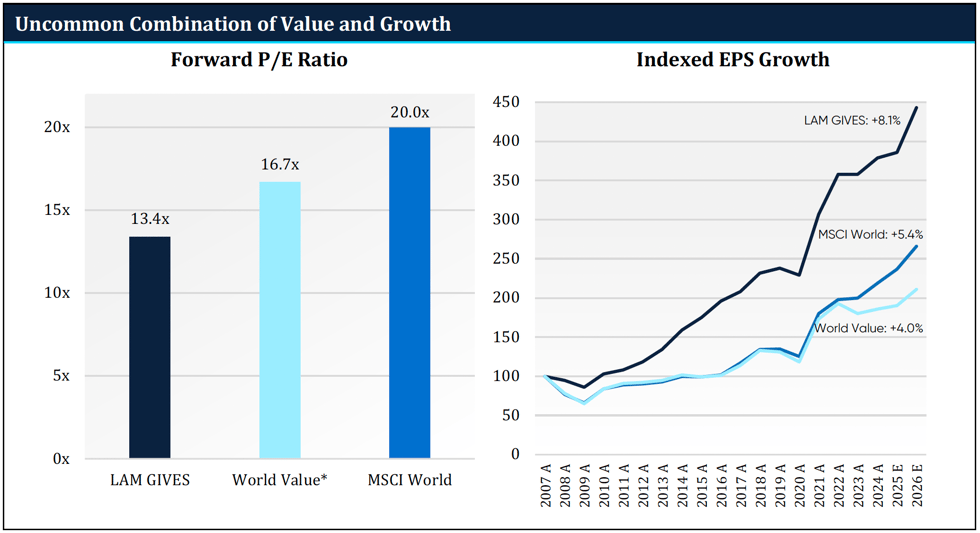
In addition to their value, our stocks also have quality growth. This uncommon combination of value and growth is the signature feature of Lyrical’s portfolios. Shown in the bar chart below on the left is a summary of our current valuation, as well as the valuations of our benchmarks. Valuation is important, but it isn’t everything. What matters in investing is not just what you pay, but also what you get, specifically what you get in terms of the future earnings.
Shown in the line graph below on the right is the growth profile of our portfolio and the benchmarks. The lines at the top show the EPS growth history of our current GIVES portfolio, while the lines below them show the EPS growth of the MSCI World Index and the MSCI World Value Index.
From 2007 to 2026, the MSCI World Index has had an annualized EPS growth history of 5.4%. By contrast, our current portfolio has a growth history that is nearly three percentage points faster, at 8.1%. This growth profile is why we continue to believe the wide valuation spread justifiably deserves to narrow significantly from its current level.
CONCLUSION
We have generated strong out performance in a period that has been tough for sustainability-focused indices and stocks. Our valuation discipline helped us avoid commonly owned and expensively priced stocks that have struggled in the past three years. With GIVES outperforming the MSCI Sustainable Impact Index by 47.3% over the past three years, we believe we have proven the merits of an impact investing strategy that is deeply rooted in value investing.
In addition to our solid financial performance, we have established a strong net zero framework and stewardship program. As long-term shareholders (our average holding period has been 7-8 years), we are able to effect change in such periods as shown by our recent work with Wesco.
Looking forward, we see significant opportunities due to our exposure outside of the mega-caps and given the valuation and growth characteristics of our portfolio.
Our portfolio remains cheap at 13.4x forward earnings, even after our 31% return last year. That represents a 33% discount to the MSCI World Index for a portfolio that has achieved faster earnings growth.
Our current portfolio has a history of 8.1% earnings growth, 250 basis points better than that of the MSCI World. While fundamentals can be ignored in the short term, we maintain our core belief that earnings fundamentals are all that matters in the longterm. If our companies keep compounding earnings, their stock prices should follow. Additionally, if their growth continues to match or beat the MSCI World Index, their valuations should expand too, increasing their stock prices even more.
That is the Lyrical way.
Co-Portfolio Managers
DISCLAIMERS:
General:
Past performance is not necessarily indicative of future results. Individual results may vary based on timing of investments and/or other factors. There is no guarantee that the investment objective of our strategy will be achieved.
This document is confidential and does not convey any offering or the solicitation of any offer to invest in the strategy presented. Any such offering can only be made following a one-on-one presentation, and only to qualified investors in those jurisdictions where permitted by law.
The information included in this document is not being provided in a fiduciary capacity, and it is not intended to be, and should not be considered as, impartial advice.
“Forward-looking statements” contained herein can be identified by the use of forward-looking terminology such as “may,” “will,” “should,” “expect,” “anticipate,” “project,” “estimate,” “intend,” “continue,” or “believe,” or the negatives thereof or other variations thereon or comparable terminology. Due to various risks and uncertainties, actual events, results or actual performance may differ materially from those reflected or contemplated in such forward-looking statements. Nothing contained herein may be relied upon as a guarantee, promise, or assurance or as a representation as to the future.
Certain information contained herein has been obtained from third party sources and not independently verified by Lyrical. No representation, warranty, or undertaking, expressed or implied, is given to the accuracy or completeness of such information. While such sources are believed to be reliable, Lyrical does not assume any responsibility for the accuracy or completeness of such information. Lyrical does not undertake any obligation to update the information contained herein as of any future date.
More complete information about our products and services is contained in our Form ADV, Part 2.
Registration with the SEC does not imply a certain level of skill or training.
Disclosed holdings:
Lyrical disclaims any duty to update historical information included herein, including whether we continue to hold positions that are mentioned. In the interest of our clients, reporting as to positions in transition (being purchased or sold) is lagged at our discretion. Generally, securities which have not been purchased for all accounts are not reflected as held and sales of positions which remain in any client accounts similarly are not reflected.
Specific investments described in this document do not represent all investments by Lyrical. You should not assume that investment decisions we include were or will be profitable. Specific investment examples are for illustrative purposes only and not necessarily representative of investments that will be made in the future. A list of all prior investment recommendations is available upon request.
Model or hypothetical performance:
Where we provide information about performance that is not the actual performance results of our investment strategies (such as where we show the results of price-to-earnings quintiles), please note that there are substantial additional limitations inherent in using such performance information. Those include, but are not limited to, that actual trading and the associated expenses did not occur, that market conditions change over time, and that no investor had the actual performance presented.
IMPORTANT NOTES:
Index Information:
Any indexes and other financial benchmarks shown are provided for illustrative purposes only, are unmanaged, reflect reinvestment of income and dividends and do not reflect the impact of advisory fees. Investors cannot invest directly in an index. Comparisons to indexes have limitations because indexes have volatility and other material characteristics that may differ from those of Lyrical’s strategies.
The MSCI World Index is an equity index which captures large and mid cap representation across 23 developed market countries around the world. With 1,480 constituents, index covers approximately 85% of the free float-adjusted market capitalization in each country.
The MSCI World Value Index captures large and mid cap securities exhibiting overall value style characteristics across 23 Developed Markets countries around the world. The value investment style characteristics for index construction a redefined three variables: book value to price, 12-month forward earnings to price and dividend yield.
The MSCI World Equal Weighted Index represents an alternative weighting scheme to its market cap weighted parent index, the MSCI World Index.The index includes the same constituents as its parent (large and mid cap securities from 23 Developed Markets countries*). However, at each quarterly rebalance date, all index constituents are weighted equally, effectively removing the influence of each constituent’s current price (high or low).Between rebalances, index constituent weightings will fluctuate due to price performance.
The MSCI World Sustainable Impact Index is an equity index whose holdings address at least one of the world’s social and environmental challenges, as defined by the United Nations Sustainable Development Goals. To be eligible for inclusion in the Index, companies must generate at least 50% of their sales from one or more of the Sustainable Impact categories and maintain minimum environmental, social and governance (ESG) standards. The parent index is the MSCI ACWI.
The S&P 500® is widely regarded as the best single gauge of large-cap U.S.equities. The index includes 500 leading companies and covers approximately 80%of available market capitalization.
Indexed EPS
The chart on page 7 depicts the historical change of earnings per share of the companies comprising the LAM GIVES portfolio as of December 31, 2025 using current composite share holdings as of that date. This chart also shows the change in earnings per share of the MSCI World Index and MSCI World Value* over the same period. Earnings per share is computed using consensus earnings data, which include certain adjustments from reported, GAAP earnings. Periods marked with an “E” include estimated earnings per share. LAM Global portfolio holdings are included from the earliest date of their available data.
Past performance is not necessarily indicative of future results.
LAM - GIVES results are unaudited and subject to revision, are for a composite of all accounts. Net returns include a 0.85% base fee and show all periods beginning with the first full month in which the advisor managed its first fee-paying account.
