
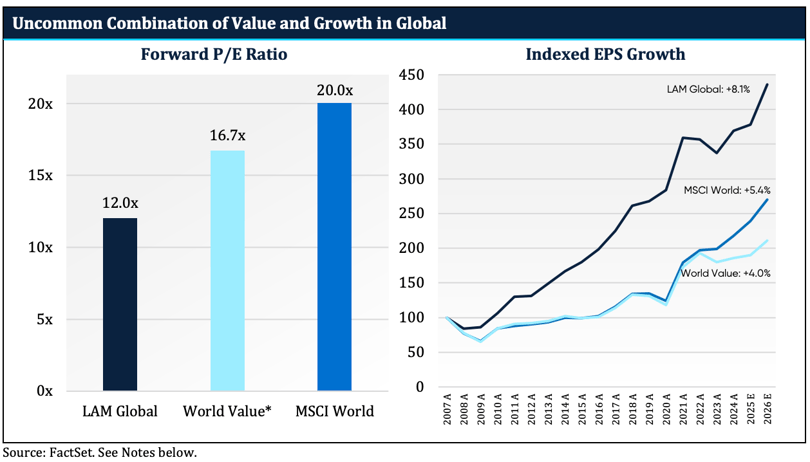
We continue to have high expectations for forward returns given the valuation and growth characteristics of our portfolio. Our global portfolio remains extremely cheap at 12.0x EPS, even after generating a 21% return for the year. That represents a 40% discount to the MSCI World for a portfolio that has achieved faster earnings growth. Our current portfolio has a history of 8.1% EPS growth, 250 basis points faster than that of the MSCI World.
If our companies continue to grow as fast or faster than the MSCI World, the wide valuation discount should justifiably narrow, delivering outperformance. That is the Lyrical formula for success.
U.S. MARKET REVIEW: WINNING WITHOUT THE MEGA CAPS
Our U.S. stocks, which represent 63% of the portfolio at year-end, delivered a 17.5% return in the year, keeping up with the S&P 500 and the U.S. portion of the MSCI World, which generated a similar return. In this section, we refer to the S&P 500, which is a good proxy for U.S. returns within the MSCI World Index. The table below shows this was difficult to do without mega cap tech stocks. Alphabet and NVIDIA combined added 3.6 percentage points to the S&P 500 return. Without them the S&P 500 return would have been 14.3%.
Other mega-cap growth stocks outside the Magnificent Seven also made outsized contributions to the S&P 500 return. As a result, the S&P 500 Equal Weight index returned 11.4%, 6.5 percentage points below the S&P 500, and an additional 2.9 percentage points below the S&P 500 excluding Alphabet and NVIDIA.
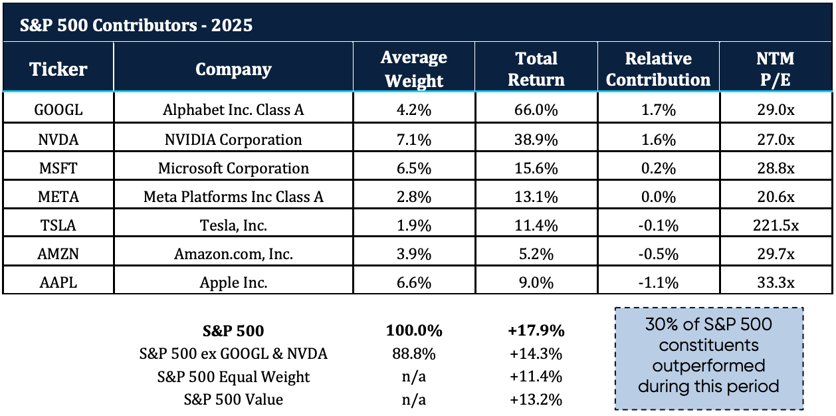
We have not owned any of the mega cap growth stocks that have inflated U.S. returns, yet our U.S. stocks still matched the S&P 500 performance and significantly outperformed the S&P 500 Equal Weight and S&P 500 Value indices.
While we have not owned any of the expensive AI-related mega-cap growth stocks, four of our top U.S. contributors in the year benefitted from the expected spending on AI technology. These stocks, shown in the table below, included NRG Energy (an independent power producer), Johnson Controls (a provider of HVAC products and services), Flex (a contract manufacturer and leading provider of critical equipment to hyperscalers), and United Rentals (the world’s largest construction equipment rental company).
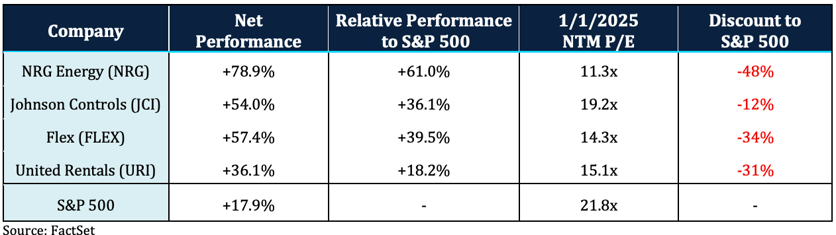
Closer to fair value is Johnson Controls, which ended the year with a forward P/E of 22.8x adjusting for non-cash amortization. Lastly, United Rentals reached our estimate of intrinsic value in September after a 36% increase year-to-date, and we sold it from the portfolio.
NON-U.S. REVIEW: A HISTORIC YEAR FOR BANKS
Outside of the U.S., there are fewer large AI-related stocks, making the AI theme less relevant. Technology stocks in the EAFE were up 50% in the year, but with a weight of only 8.5%, they drove just about four percentage points of total contribution to the EAFE, or 12% of the index return. In our non-U.S. stocks, only Samsung (the world’s largest memory chip maker) captured the market’s AI enthusiasm. This stock was up 130% in the year, adding 1.8 percentage points to our global return.
In non-US stocks, the storyline was large banks, which had a banner year. Large banks in the EAFE and MSCI World indices rose by a staggering 58% and 45%, respectively, driving 8.6 and 3.7 percentage points of return or 37% and 21% of the total. This is especially meaningful for Lyrical as value investors because many of our peers own these stocks, while we’ve avoided them explicitly. Given the stellar year banks had in 2025, it’s worth asking if Lyrical is missing out by avoiding banks.
We do not own banks, but with performance like that, it’s fair to ask us why. We avoid banks because they are fragile businesses, which makes them unanalyzable. At Lyrical we seek to own resilient companies. By resilient, we mean business structures that can absorb large challenges, such as recessions, and manage them into smaller problems. Banks tend to exhibit the opposite characteristics. With fragile businesses, relatively small problems can compound into much larger ones. In the case of banks, their fragility is structural for two main reasons.
First, banks require significant leverage to earn an adequate return. Even after a decade of post financial crisis reform, the average common equity Tier 1 capital ratio across large European banks is 15.9%. Simply put, this means that European banks have about 16 euros of equity supporting every 100 euros of assets. As a result, relatively small loan losses can compound into large impairments of equity. This can then compound further as investors sell shares and customers withdraw deposits. This illustrates the second major source of a bank’s fragility, which is that banks depend heavily on the confidence of their depositors and investors, which once lost can be difficult to earn back.
These vulnerabilities are well documented. In the past 20 years, we’ve seen: the Global Financial Crisis, the Eurozone Sovereign Debt Crisis, the collapse of Silicon Valley Bank and the ensuing U.S. regional banking crisis, and most recently the collapse of Credit Suisse.
To be fair, we recognize that some banks will prove to be successful investments, and others will be disasters like Citigroup during the GFC and, more recently, like Silicon Valley Bank and Credit Suisse. However, we do not believe we can reliably distinguish the long-term winners from the losers. It is the fundamental nature of banking to be exposed to significant tail risk, either from credit risk, a run on the bank, or both.
This fragility and lack of analyzability are central reasons why we avoid banks. But if that weren’t enough, we have another solid reason for avoiding banks. They also tend to exhibit low earnings growth and modest long-term returns. Consider this chart, which shows that within the cheapest quintile of non-U.S. stocks, banks have underperformed by about four percentage points per year over the 20+ year period that we can calculate this back to 2003.
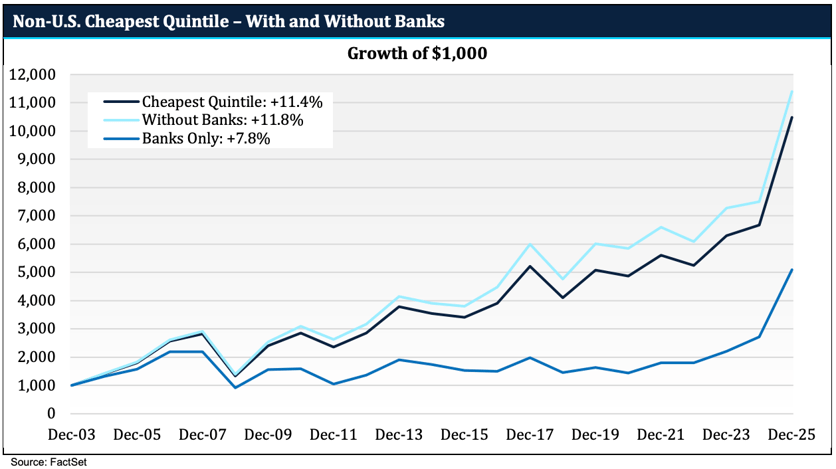
This underperformance didn’t all come from the Global Financial Crisis, although that period certainly did not help. From 2003 to 2006, banks underperformed by 7.2 percentage points per year. Then, in the financial crisis, they underperformed by 8.4 percentage points per year. Since 2010, banks performed much better, but still poorly, underperforming by 2.1 percentage points per year.
The pattern of weaker returns largely reflects subdued earnings growth. We can see that from the chart below, which refers to the European investment grade banking universe. We refer to this as the P-E-P/E chart, which shows from top to bottom, the historical price, earnings, and P/E multiple history for large European banks.
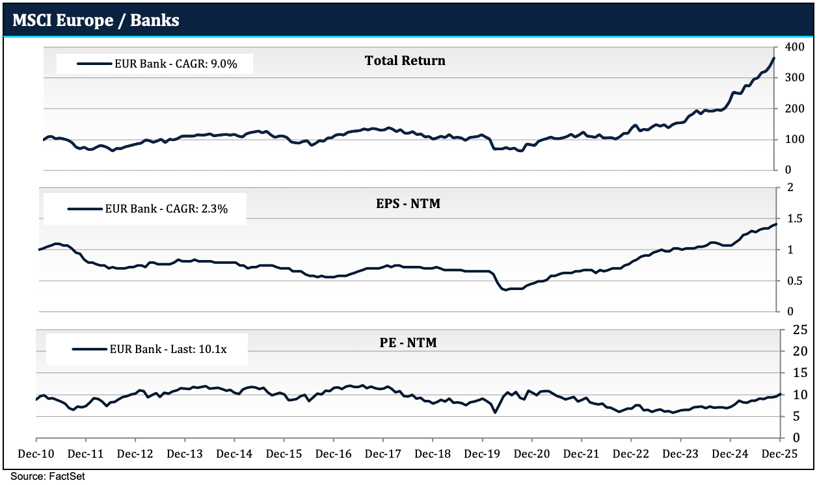
Starting in 2011, after a nearly 80% decline in earnings during the financial crisis, the earnings for the largest European banks have grown only 2.3% per year. While these stocks have performed very well recently, that performance has come mostly from multiple expansion, not earnings growth. It’s true that they still trade for only 10.1x earnings, but, as we just discussed, they fail on both our quality and analyzability criteria.
AERCAP: A SUPERIOR FINANCIAL
As seasoned value investors, we know firsthand that bad companies can have very good years. We’ve also learned that such years are difficult to predict, and that it’s much easier to generate strong long-term results by buying companies that are not only cheap but also capable of consistent earnings growth. Oftentimes, we find these good businesses in the same sectors and industries as bad companies. Even though we don’t own banks, we do invest meaningfully in financial services, as we have found several other financial companies in the cheapest quintile with better growth, higher predictability, greater resilience, and materially less tail risk.
Take, for example, AerCap (the world's largest aircraft leasing company) owns over 1,500 aircraft that it leases to airlines globally. The business model is straightforward and far easier to analyze than a bank: AerCap buys planes, leases them to airlines on long-term contracts—typically eight to ten years—and then ultimately sells them into the secondary market. The company earns a spread between its cost of funding and the lease rates it charges, and because it is the largest player, it can buy planes at a discount and earn a structurally higher ROE, typically in the low to mid-teens.
Unlike banks, AerCap's balance sheet is transparent and predictable. The assets are physical planes with clear market values. The leases are non-cancellable and secured by the aircraft itself, and if an airline stops paying, AerCap repossesses the plane. And, critically, AerCap matches the duration of its leases to its liabilities, eliminating the maturity mismatch risk that can plague banks. Even during COVID, the worst imaginable environment for the airline industry, AerCap generated positive cash flow and was considered so resilient that it was able to raise debt at a rate just above 3%.
These strengths are evident in the company’s fundamentals. As shown in the middle chart below, AerCap has delivered 14.7% annualized earnings growth since 2009, compared with European banks at 2.3%. On the left, we see that this earnings growth has driven substantial stock outperformance, with AerCap generating a total return of 16.9% over this period versus just 9% for banks.
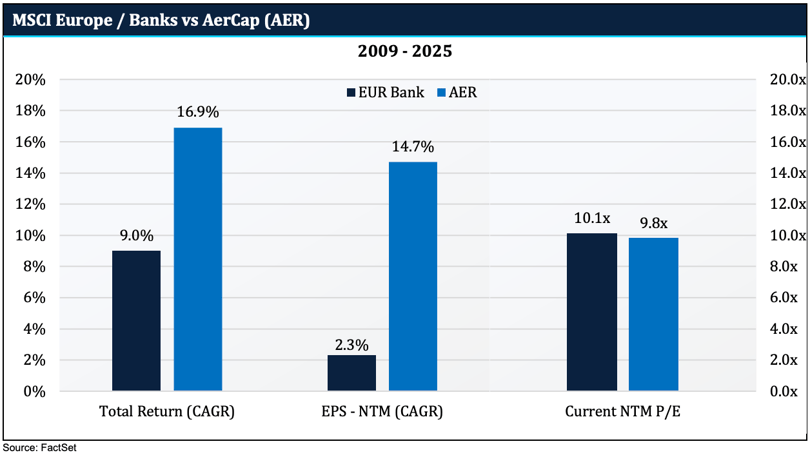
As for valuation, shown on the right side, AerCap is as cheap as the European banks at only 9.8x earnings, and yet it is a far more analyzable and a compounder-friendly business model. We'd much rather own AerCap than make a blind bet on which banks will survive the next crisis.
NOT ALL EARNINGS GROWTH WAS REWARDED
The fundamentals of our portfolio were strong throughout the year, with total earnings growth of 14.2%, exceeding that of the MSCI World at 9.6%. But not all this growth was rewarded.
As shown below, in a year when the MSCI World’s P/E multiple expanded by 6%, only 61% of our stocks experienced multiple expansion. Unsurprisingly, these stocks were the ones with the best fundamentals; they grew EPS at a 17.1% rate and benefitted from an 18% boost in valuation. These winners were still attractively valued at year-end with an average P/E of just 12.6x, a 37% discount to the MSCI World P/E of 20.0x.
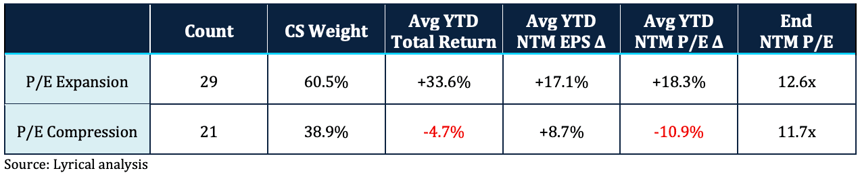
Those stocks propelled our returns and are the reason why we had a favorable 2025. However, the year’s performance could have been even better if we did not suffer from multiple compression in most of the remaining portfolio. As we show in the bottom row of the table, 21 of our stocks accounting for 39% of our portfolio grew earnings by 8.7%. That is comparable to the 9.6% EPS gain for the MSCI World. However, rather than appreciate in valuation like the MSCI World, these stocks suffered an 11% multiple contraction and ended the year at only 11.7x EPS. If those stocks had just maintained their cheap multiples instead of getting cheaper, that would have contributed over 500 basis points to our returns. Given their strong fundamentals and now even lower valuation, we believe they could be a major contributor to performance in 2026 and beyond.
WAITING, PATIENTLY, FOR THE PAYOFFS
We had a solid year in 2025 because of these fundamentals, not because of market factors. That said, we are well positioned to take advantage of mean reversion in two major areas of the market: size and value.
First, size has been a major headwind, but we expect that to turn to a tailwind in the future. With a weighted average market cap of $36 billion, our portfolio looks much more like the MSCI World Equal Weighted index, which has a $74 billion average market cap, than the MSCI World Index, which has a $1,029 billion average market cap. This has resulted in a significant headwind. As shown below, since we launched our fund in November 2019, the cap-weighted MSCI World has outperformed the equal-weighted MSCI World by 4.6 percentage points per year.
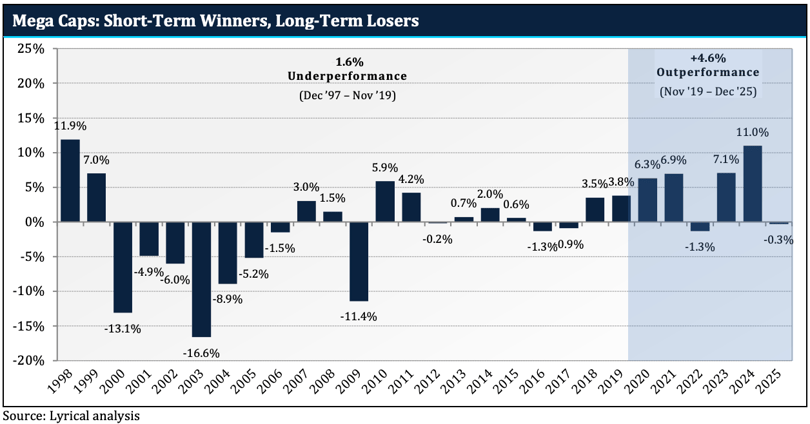
Larger market caps beating smaller market caps with this level of magnitude and duration is highly unusual, and we don’t expect it to last. As also shown above, between December 1997 and September 2020, the cap-weighted version of the index underperformed the equal weight by 1.6 percentage points per year. The current period of mega cap outperformance looks most like the period experienced in 1998 and 1999, during the tech bubble, when mega cap stocks massively outpaced the market before collapsing.
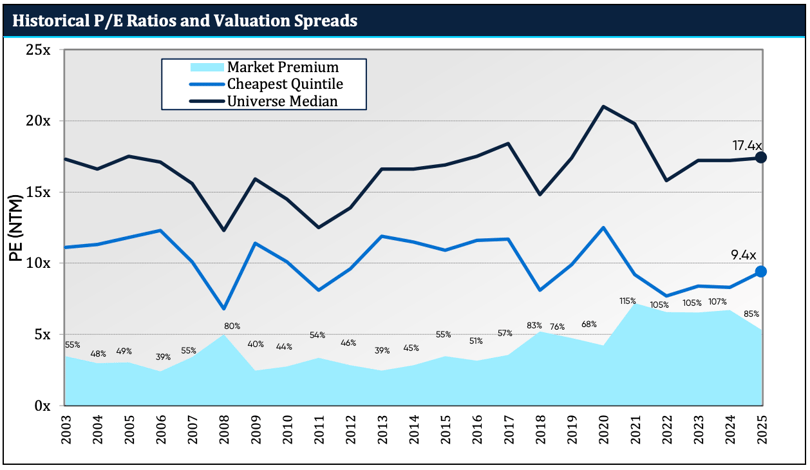
Another mean reversion opportunity that reminds us of ’98-’99 is the value factor. Below we show the median P/E multiple of global developed market stocks in the dark blue line, and the median P/E of the cheapest 20% of stocks in the royal blue line below it. The bars at the bottom show the spread between the two lines, or how expensive the market is relative to the cheapest part of the market. With a spread of 85% today, the market is priced at a similar valuation spread to where it was at the end of 1999. This was right before value stocks went on their best period of relative performance that we have data for. From March 2000 to July 2007, the cheapest quintile of global stocks outperformed the MSCI World by 18.7 percentage points, delivering a 22.4% annual return versus the MSCI World at only 3.7%.
While it’s easy to see that the magnitude of potential returns from size and value is significant, it is impossible to say when these returns will be realized. Fortunately, we can afford to be patient. Unlike the typical value stock, our companies have strong earnings growth which can carry us through periods when the market is not in our favor.
OUR UNCOMMON COMBINATION
Not only is our portfolio significantly cheaper than the MSCI World (shown below in the bar chart on the left), but our portfolio also has a faster growth profile, as shown in the line graph on the right.
The lines at the top show the EPS growth history of our current composites, while the lines below them show the EPS growth of the MSCI World and MSCI World Value.
Dating back to 2007, the MSCI World has had an annualized EPS growth history of 5.4%. Our current portfolio has a much better history of 8.1% EPS growth, nearly three percentage points faster than the MSCI World.
Our confidence in our ability to outperform is rooted in our combination of valuation and growth. If our portfolio’s EPS continues to grow as fast or faster than the MSCI World, we should be able to perform as well or slightly better, as long as our relative multiple stays where it is. But if our companies continue to grow as fast or faster than the MSCI World, the wide discount should justifiably narrow, delivering additional outperformance.
CONCLUSION
2025 was a respectable year for Lyrical’s global portfolio. We produced strong absolute returns of 21.1% matching the MSCI World despite not owning Magnificent Seven stocks or benefitting from a boost in non-U.S. banking stocks.
Looking forward, we see significant opportunities in our exposure outside of the mega caps and in quality value stocks, but we cannot know when these returns will be realized. That said, 2025 presents an example of how we can afford to be patient. Even without market forces as a tailwind, we generated a strong return, driven by 14.2% EPS growth, well ahead of the 9.6% of the MSCI World. Even so, about 40% of our portfolio faced multiple contraction, despite delivering similar EPS growth to the MSCI World. This leaves us at a 40% discount to the MSCI World despite better EPS growth in 2025 and over the long-term.
While fundamentals can be ignored in the short term, we maintain our core belief that earnings fundamentals matter in the long term. If our companies continue to compound earnings, their stock prices should follow. Additionally, if their growth continues to match or outpace the MSCI World, their valuations should expand too, increasing their stock prices even more.
That is the Lyrical way.
Co-Portfolio Managers
RISK FACTORS:
General:
We do not attempt to time the markets or focus on weightings relative to any index. Accordingly, client returns are expected, at certain times, to significantly diverge from those of market indices.
Investing in securities involves a risk of loss that investors must be prepared to bear. Because we invest primarily in publicly traded equity securities, Lyrical believes the primary risk of loss is associated with securities selection and broad market movements, and wide and sudden fluctuations in market value can occur.
Force Majeure. Lyrical and its clients may be affected by force majeure events (i.e., events beyond the control of the party claiming that the event has occurred, including, but not limited to, acts of God, fire, flood, earthquakes, outbreaks of an infectious disease, pandemic or any other serious public health concern, war, terrorism, labor strikes, major plant breakdowns, pipeline or electricity line ruptures, failure of technology, defective design and construction, accidents, demographic changes, government macroeconomic policies, social instability, etc.). Some force majeure events may adversely affect the ability of a party (including a portfolio company or service provider) to perform its obligations until it is able to remedy the force majeure event. These risks could, among other effects, adversely impact the cash flows available from a portfolio investment, cause personal injury or loss of life, damage property, or instigate disruptions of service. In addition, the cost to a portfolio company or a client of repairing or replacing damaged assets resulting from such force majeure event could be considerable. Force majeure events that are incapable of or are too costly to cure can have a permanently adverse effect on a portfolio company. Certain force majeure events (such as war or an outbreak of an infectious disease) could have a broader negative impact on the world economy and international business activity generally, or in any of the countries in which we invest.
International Risks:
International holdings involve risks and considerations not typically associated with investing in U.S. companies. The performance of foreign markets does not necessarily track U.S. markets. Foreign investments may be affected favorably or unfavorably by changes in currency rates and exchange control regulations. There may be less publicly available information about a foreign company than about a U.S. company, and foreign companies may not be subject to accounting, auditing and financial reporting standards and requirements comparable to those applicable to U.S. companies. Foreign securities often trade with less frequency and volume than domestic securities and therefore may exhibit less liquidity and greater price volatility than securities of U.S. companies. There may be less governmental supervision of securities markets, brokers, and issuers of securities than in the U.S. Changes in foreign exchange rates will affect the value of those securities, which are denominated or quoted in currencies other than the U.S. dollar. Therefore, for foreign securities which are denominated or quoted in currencies other than the U.S. dollar, there is a risk that the value of such security will decrease due to changes in the relative value of the U.S. dollar and the securities’ underlying foreign currency. Additional costs associated with an investment in foreign securities may include higher custodial fees than those applicable to domestic custodial arrangements, generally higher commission rates on foreign portfolio transactions, and transaction costs of foreign currency conversions. Investments in foreign securities may also be subject to other risks different from those affecting U.S. investments, including local political or economic developments, expropriation or nationalization of assets, restrictions on foreign investment and repatriation of capital, imposition of withholding taxes on dividend or interest payments, currency blockage (which would prevent cash from being brought back to the U.S.), limits on proxy voting and difficulty in enforcing legal rights outside the U.S. Currency exchange rates and regulations may cause fluctuation in the value of foreign securities. In addition, foreign securities and dividends and interest payable on those securities may be subject to foreign taxes, including taxes withheld from payments on those securities.
“Fair and balanced” assessment:
You are entitled to a fair and balanced presentation, to inform any decision about investing with us. And, no such decision should be based entirely or predominantly on information in this document. By design, our investment approach differs from the norm in important ways. While those differences are intentional and, we believe, well-founded, we allow that those who act more conventionally, too, have reasons for doing so. We strongly encourage that you engage with our client service team to better understand our beliefs and our methods. Questions could be as general as “why value?” or as narrow as “why do you not conviction-weight positions?” for just two examples. Even as our strategies offer liquidity, we seek an alignment of long-term minded investors and our long-term orientation; the better you are informed, the more likely that match will be made.
General:
Past performance is not necessarily indicative of future results. Individual results may vary based on timing of investments and/or other factors. There is no guarantee that the investment objective of our strategy will be achieved.
This document is confidential and does not convey any offering or the solicitation of any offer to invest in the strategy presented. Any such offering can only be made following a one-on-one presentation, and only to qualified investors in those jurisdictions where permitted by law.
The information included in this document is not being provided in a fiduciary capacity, and it is not intended to be, and should not be considered as, impartial advice.
“Forward-looking statements” contained herein can be identified by the use of forward-looking terminology such as “may,” “will,” “should,” “expect,” “anticipate,” “project,” “estimate,” “intend,” “continue,” or “believe,” or the negatives thereof or other variations thereon or comparable terminology. Due to various risks and uncertainties, actual events, results or actual performance may differ materially from those reflected or contemplated in such forward-looking statements. Nothing contained herein may be relied upon as a guarantee, promise, or assurance or as a representation as to the future.
Certain information contained herein has been obtained from third party sources and not independently verified by Lyrical. No representation, warranty, or undertaking, expressed or implied, is given to the accuracy or completeness of such information. While such sources are believed to be reliable, Lyrical does not assume any responsibility for the accuracy or completeness of such information. Lyrical does not undertake any obligation to update the information contained herein as of any future date
More complete information about our products and services is contained in our Form ADV, Part 2
Registration with the SEC does not imply a certain level of skill or training.
Disclosed holdings:
Lyrical disclaims any duty to update historical information included herein, including whether we continue to hold positions that are mentioned. In the interest of our clients, reporting as to positions in transition (being purchased or sold) is lagged at our discretion. Generally, securities which have not been purchased for all accounts are not reflected as held and sales of positions which remain in any client accounts similarly are not reflected.
Specific investments described in this document do not represent all investments by Lyrical. You should not assume that investment decisions we include were or will be profitable. Specific investment examples are for illustrative purposes only and not necessarily representative of investments that will be made in the future. A list of all prior investment recommendations is available upon request.
Model or hypothetical performance:
Where we provide information about performance that is not the actual performance results of our investment strategies (such as where we show the results of price-to-earnings quintiles), please note that there are substantial additional limitations inherent in using such performance information. Those include, but are not limited to, that actual trading and the associated expenses did not occur, that market conditions change over time, and that no investor had the actual performance presented.
IMPORTANT NOTES:
Index Information:
Any indexes and other financial benchmarks shown are provided for illustrative purposes only, are unmanaged, reflect reinvestment of income and dividends and do not reflect the impact of advisory fees. Investors cannot invest directly in an index. Comparisons to indexes have limitations because indexes have volatility and other material characteristics that may differ from those of Lyrical’s strategies.
The MSCI World Index captures large and mid-cap representation across 23 Developed Markets (DM) countries*. With 1,320 constituents, the index covers approximately 85% of the free float-adjusted market capitalization in each country.
The MSCI World Value Index captures large and mid cap securities exhibiting overall value style characteristics across Developed Markets countries. The value investment style characteristics for index construction are defined using three variables: book value to price, 12-month forward earnings to price and dividend yield.
The MSCI World Equal Weighted Index represents an alternative weighting scheme to its market cap weighted parent index, the MSCI World Index. The index includes the same constituents as its parent (large and mid cap securities from Developed Markets countries). However, at each quarterly rebalance date, all index constituents are weighted equally, effectively removing the influence of each constituent's current price (high or low). Between rebalances, index constituent weightings will fluctuate due to price performance.
The MSCI EAFE Index is designed to represent the performance of large and mid-cap securities across 21 developed markets, including countries in Europe, Australasia and the Far East, excluding the U.S. and Canada. The Index is available for a number of regions, market segments/sizes and covers approximately 85% of the free float-adjusted market capitalization in each of the 21 countries.
The S&P 500® is widely regarded as the best single gauge of large-cap U.S. equities. The index includes 500 leading companies and covers approximately 80% of available market capitalization.
The S&P 500® Value measures constituents from the S&P 500 that are classified as value stocks based on three factors: the ratios of book value, earnings and sales to price.
The S&P 500® Equal Weight Index (EWI) is the equal-weight version of the widely-used S&P 500. The index includes the same constituents as the capitalization weighted S&P 500, but each company in the S&P 500 EWI is allocated a fixed weight - or 0.2% of the index total at each quarterly rebalance.
Indexed EPS
The chart on page 9 depicts the historical change of earnings per share of the companies comprising the LAM Global portfolio as of December 31, 2025 using current composite share holdings as of that date. This chart also show the change in earnings per share of the MSCI World Index and MSCI World Value Index over the same period. Earnings per share is computed using consensus earnings data, which include certain adjustments from reported, GAAP earnings. Periods marked with an “E” include estimated earnings per share. LAM Global portfolio holdings are included from the earliest date of their available data.
Past performance is not necessarily indicative of future results.
LAM - Global results are unaudited and subject to revision, are for a composite of all accounts. Net returns include a 0.75% base fee and show all periods beginning with the first full month in which the advisor managed its first fee-paying account.
